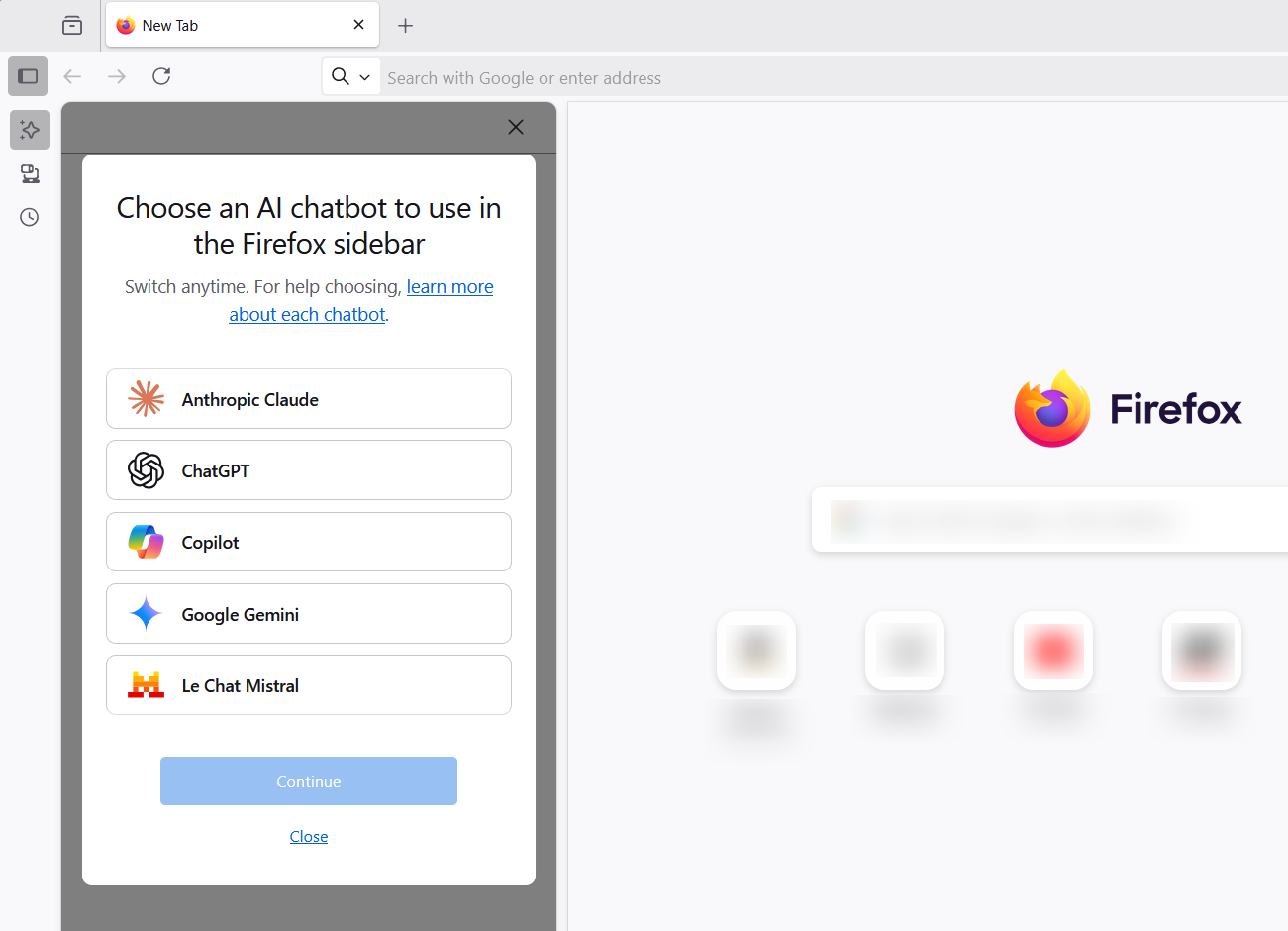
Genuinely can someone with knowledge of the business explain why they aren't simply doubling down on making Firefox better? Is there an existential problem facing them that they are trying to solve by adding AI into the browser?
Their Google dependency is their existential problem. They're limited by what they can do with "making Firefox better" while effectively being a client state. An off the books Google department. Doomed to forever being a worse funded Chrome because they can't do too much to anger their patron.
By selling browser UI real estate to AI companies[0] they reduce the power Google has over them. If they get to the point where no individual company makes up a majority of their revenue, it allows them to focus on their mission in a much broader way.
Yeah but is this entirely true though? It seems Google pays FF just for existing, to protect them from antitrust litigation (or what's left of it); so Google can't really stop paying FF and can't try to kill it, as its death would be extremely counter productive. FF may be freer than it thinks.
Same as for Apple, the amount Google pays will vary. Firefox will probably still exist with 10% of Google's money, except execs Mozilla execs would be in a very different situation.
Its not impossible that someday a new non-chromium browser reaches feature parity (or close enough) with the chromium browsers. At that point, Google could stop worrying about funding Firefox's development.
Google pay Mozilla hundreds of millions of dollars each year to place Google as the default browser. It's by far their biggest income stream. In 2023 it was reported as 75% of their revenue.
There's no world in which 75% of your revenue coming from Google doesn't influence what you do. Even if it's not the main driver of all decisions, pissing off Google is a huge risk for them.
If the plaintiff pays 500 million to the judge and the defendant goes to jail, there's no proof that the judge wouldn't have made the same decision without the 500 million. If you're a fool, you'll sneer and ask "Where's the proof?"
Well if you bring up law how about: innocent until proven guilty?
Google is not bribing Mozilla...they probably keep them alive to avoid all kinds of monopoly lawsuits. With their market share however, you would need more prove to justify further conspiracies...
I'm not sure how well know this is, but besides their contract with Google to be the default search option, Firefox does earn money through revenue share with all other default search options. A normal healthy company would just rely on those. Growing the user base would therefore grow the amount of rev-share income. So improving the product by itself, and thus attracting users, does make money - and probably enough to run Firefox and Mozilla. Just not enough to pay their CEO.
They don't really need money. Look at Mozilla's CEO compensation for example. It was 7 million USD in 2022. Seven. Million. For ruining a bastion of the open internet.
is that too much money for one person? well, apparently it depends on who do you ask. and even if the board members who approved it might thought it's too much, it still could have been cheaper than to fire the CEO and find a new one and keep Mozilla on track.
CEO compensation is usually a hedge against risks that are seen as even more costly, even if the performance of the CEO is objectively bad.
framing Mozilla/Firefox as some kind of bastion is simply silly - especially if it's supplied by the gigantic fortress kingdom of G, and makes more money on dividends and interest than on selling any actual products or services.
it's a ship at sea with a sail that's too big and a rudder that's unfortunately insignificant.
but whatever metaphor we pick it needs to transform into a sustainable ecosystem, be that donation or sales based.
Just because something bad has been normalized doesn't make it appropriate, though.
You can argue that they won't find another CEO for less money. To that I would posit that they won't find another CEO from the MBA crowd for less money, but that is a feature, not a bug.
it's a completely obvious "problem" -- more users are easier to monetize, even if they "simply" go the Wikipedia donations model
many people stated that they are happy to do targeted donations (ie. money earmarked strictly for Firefox development only, and it cannot be used for bullshit outreach programs and other fluff)
and if they figure out the funding for the browser (and other "value streams") then they can put the for-profit opt-in stuff on top
Google pays Mozilla, Mozilla has more money, Mozilla spends more money (especially in compensations to a bloated C-level), Mozilla needs more money, Google threatens with paying less, Mozilla will lube up and bend over.
You can't monetize a browser. They have to keep trying to create new products, but they inevitably fail. Pocket, FirefoxOS, Persona, all dead. This new stuff will fail too, because Mozilla has no USP and no way to create a best-in-class product in any market. So they rely on imitating what everyone else is doing, but with more "crunchy" vibes ("values", "trust", "we're a nonprofit") because that's the only angle they can compete on. They missed mobile completely so even their browser is bleeding users and dying.
The way to interpret Mozilla is that they're a dying/zombie company, fighting heroically to delay the inevitable.
I'd pay $10 a month for a browser, I pay that much for music and TV shows and I spend more time in a browser.
I'm sure the market doesn't agree with me but I pay more for things that are less useful.
You very much can if all the competitors are either a) ad-ridden, ai-infested, bloated monstrosities or b) don't provide the functionality people want. In that case, there's apparently lots of demand which could easily support either a pay-once or a low-subscription-fee model.
What they could do is get funding from sovereign tech funds.
I don't think the rest of the world likes their dependencies on US companies and their love for surveillance.
Of course, to do it right means ensuring there's enough non-US organizational structure with the know-how to take over the project should things go pear-shaped, and oversight to spot of the pear is taking shape.
But that's what governments can do, assuming they don't want to be under the thumb of the US. ("Oh, you think tariffs are bad? We'll do to you like we did those ICC judges and shut off all your accounts.")
They already do monetize it, every search engine included by default paid to be there. They forcefully remove those that don't pay from existing installations without the user's permission, as they did with yandex.
Fork Firefox, bundle uBlock Origin, Sponsor Block et el and sell it is a consumer web security product (that's not complete shit) with a monthly subscription. Use some of the proceeds to support the devs working on the underlying tech, similar to what Valve are doing for Wine, Proton and Fex.
Bonus points:
1. Multi layered approach to dealing with ads and other malware.
2. A committment to no AI or other bloat - that's not what I'm paying you for.
I think that's false, with the current state of internet, advertising everywhere, enshitification and monetization of users private data, some people are ready to pay for services that were considered "free".
I am paying for kagi, and I would pay for a good, private browser (I know they make onion but I'm on linux, not macos or windows).
Vivaldi is a decent option if you aren't specifically looking to get off Blink as the engine. It has an integrated adblocker and many other privacy-related features.
But I'm not pitching a browser. This is a web security product which people do pay for - it's a billion dollar product category in fact. The only functional difference is that the malware and fraud protection it provides is demonstrably superior to all of its competitors.
Please enlighten me. How does one make a browser "better" these days?
- They were ahead of the game with extensions. Then everyone copied them.
- They were ahead of the game with tabs. Then everyone copied them.
- They were ahead of the game with containers. Then everyone copied them.
- They are still the best browser to use for an ad free internet experience.
- The only flaw I can think of, is they are not leaders in performance. Chrome loads faster. But that's because Chrome cheats by stealing your memory on startup.
How would you make FireFox better? When you say they should be making FireFox better, what should they be doing? Maybe they should hire you for ideas.
Because to me, they seem to be constantly trying to make FireFox better. It's just hit or miss.
Extensions was a hit. Tabs was a hit. Containers was a hit. They had a shit tonne of misses over the decades. We just don't remember them.
The crypto and ai stuff just happens to be a miss.
First, I would stop breaking up the stuff that works. Firefox was ahead of the game with extensions, then deprecated the long tail for a rewrite that took three years [1] (during which Firefox mobile had a grand total of 9 extensions) and even then it's hard for me today to know which extensions work on mobile. They were similarly ahead of the game with containers, and yet they still don't work on private mode [2] and probably never will. That's two out of three hits where they tripped over their own two feet[3].
Second, do the one thing that users have been requesting for decades: let me donate to the browser development. Not to the Mozilla Foundation, not to internet freedom causes, to Firefox. The Mozilla foundation explicitly says that they don't want to be "the Firefox company", and yet I'd argue they should.
Third, go on the offensive. I get the impression that, with the exception of ad-blocking, Firefox is simply playing catch-up to any idea coming from Chrome regardless of whether it makes sense or not. Would Firefox had removed FTP support had Chrome not done it before?
And fourth, make all these weird experiments extensions.
> [3] I always associated tabs with Opera, though.
Yeah as someone who picked up Firefox when it was Phoenix, it was “free Opera with a less-odd-feeling UI”. That was basically the initial (great!) sales pitch.
What got me installing it on any computer belonging to a person I would have to help support was the auto-pop-blocking and that it performed a ton better than IE/Netscape/Mozilla. Opera also performed better and I think it also blocked pop ups out of the box, but it wasn’t free (well, kinda, but the free edition… had ads).
> - They were ahead of the game with extensions. Then everyone copied them.
They were ahead of the game with extensions, then they destroyed their own extensions. They copied everyone else, not the other way around.
> - They were ahead of the game with tabs. Then everyone copied them.
They were ahead of the game with tabs. Then while destroying their extensions they made vertical tabs harder, while still leaving it as a charitable contribution by the community instead of an internal project, and slow-walked it for a decade. I still have to do weird CSS to make them look right, because they decided to have an opinionated sidebar for no particular reason.
> - They are still the best browser to use for an ad free internet experience.
This, again, is not their fault. It's because of a man who they don't pay, who has had to battle with them on multiple occasions. Their only contribution is not accepting a Chrome standard completely. Imagine wanting to be given credit for not exactly copying your neighbor, after an enormous amount of pressure was brought to bear. It's my belief that Google decided that Firefox wouldn't kill ad blocking in the end, because it would have looked horrible in antitrust court. Now that's over (Obama judges don't believe in antitrust), and you can expect Firefox to kill it soon enough.
> Because to me, they seem to be constantly trying to make FireFox better. It's just hit or miss.
Nah. They kept telling me, while ignoring everyone's complaints about their actual experiences, that the most important thing was to reduce startup time for some unknown reason.
Make Firefox fully and exclusively a tool in service of the user.
Eliminate - both in code and by policy - anything that compromises privacy. If a new feature or support of a new technology reduces privacy, make it optional. Give me a switch to turn it off.
Stop opting the user into things. No more experiments. No more changing of preferences or behavior during upgrade.
Give the user more control; more opportunities for easy and powerful automation and integration.
Not only would this win me back as a user, I'd pay for the privilege. I'm paying for Kagi and happy to be doing so. I'd love to pay for an open source browser I could trust and respect.
In my experience Chrome does not just load faster, but it also uses less memory than Firefox because of its more aggressive tab hibernation that is enabled by default.
On my laptop I had to switch from Firefox to Chrome because it kept filling up all of my RAM resulting in other applications crashing.
I feel the problem they're trying to solve with that is "EB isn't sufficiently pissed off with the gradually deteriorating user experience yet so instead of actually displaying the page we'll have a big modal popup telling him how great the AI tools are and how he should try them!"
I do not want to try your AI tools, Mozilla, yours or anyone else's.
Yes it does. Having a browser that truly has the user's back, without always trying to compromise the user's interests in favor of advertisers - that would be a benefit to society.
Possibly, but that's an absurdly overbroad mission.
Organizations with clear, focused missions are much more likely to be able to achieve them than organizations that want to be everything to everybody.
"Make and maintain Firefox as the best browser for people who care about internet freedom, privacy, and extensibility" would be a perfectly reasonable mission.